
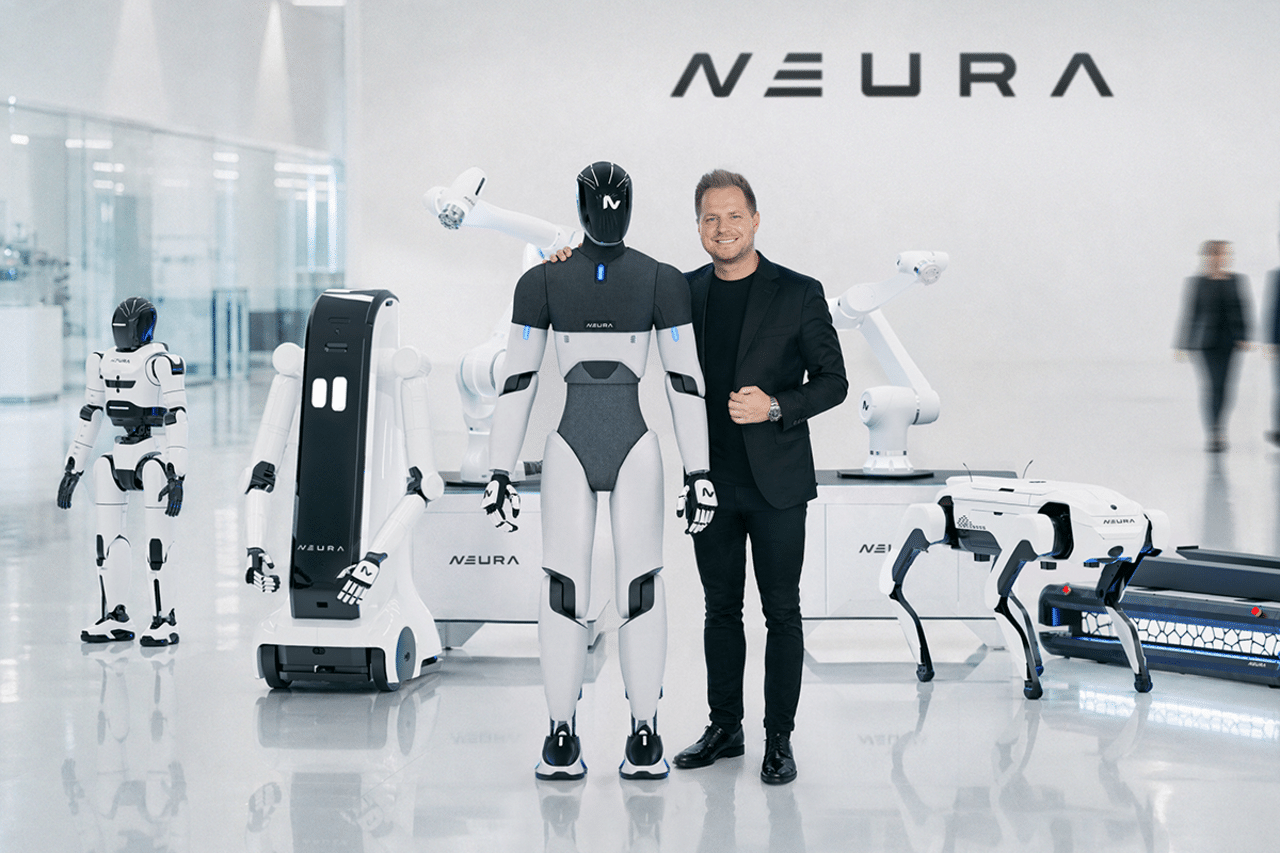
NEURA Robotics, a robotics and Physical AI company based in Metzingen, Germany, has announced a Series C funding round of up to €1.2Bn ($1.4Bn).
The round includes participation from Tether, Qualcomm Technologies, Amazon, NVIDIA, Bosch, Schaeffler, and the European Investment Bank, among others. The company will use the capital to accelerate the global deployment of its cognitive and humanoid robots, expand its Neuraverse platform, increase manufacturing capacity, and advance its Physical AI technologies.
Addressing The Market Opportunity
NEURA Robotics positions its work within a broader shift it describes as Physical AI, the extension of artificial intelligence beyond screens and into machines that can move, interact, and operate in real-world environments. According to the company, this shift will affect a wide range of sectors, including manufacturing, logistics, healthcare, services, and household robotics, marking one of the larger technological transitions of the coming decades.

How The Technology Works
NEURA Robotics builds intelligent machines designed to perceive, learn, and adapt alongside humans in physical environments. Its robots combine sensing capabilities such as vision and hearing with the software, AI systems, and data infrastructure required to operate at scale.
Central to the company’s approach is the Neuraverse, a shared intelligence platform where cognitive robots can learn from each other, collaborate, and operate across different real-world settings. NEURA Robotics describes its model as distinct from traditional robotics companies that focus on individual machines or narrow industrial tasks. Instead, the company combines robotics, artificial intelligence, sensors, edge computing, and large-scale learning systems into a single platform intended for global deployment.
Growth And Market Traction
Founded in 2019 by David Reger, NEURA Robotics previously raised €120M in a Series B round led by Lingotto Investment Management in January of the prior year. The new Series C round brings in backing from a mix of technology companies, industrial partners, and public financial institutions, reflecting growing interest in physical AI infrastructure from both private and institutional investors.
Expansion Plans
With the new funding, NEURA Robotics plans to expand manufacturing capacity with the goal of producing several million robots by 2030. The company intends to deploy its humanoid robot, 4NE1, at scale for industrial customers, beginning with sectors where demand is highest. NEURA Robotics is also expanding beyond Europe into the United States, China, and Japan, alongside plans to grow the Neuraverse platform and launch NEURA Gyms as part of its development of Physical AI technologies.
Looking Ahead
David Reger, founder and CEO of NEURA Robotics, described the company’s view of where AI is heading: “The future of AI will not only live on screens. It will move, interact, learn and work beside us in the real world. We believe Physical AI and cognitive robotics will become one of the largest technology shifts of the coming decades, transforming industries ranging from manufacturing and logistics to healthcare, services and household robotics.”
Reger also addressed the company’s position in the global robotics landscape: “Many believed globally relevant AI infrastructure companies could only emerge from Silicon Valley. We believe the next generation of AI leaders can emerge anywhere in the world where there is enough vision, engineering talent and execution speed. With this financing, NEURA is firmly among the global leaders in the robotics race, alongside the best in the US and China. At the end, this is not only about robotics. It is about building technologies the world will depend on.”
About NEURA Robotics
NEURA Robotics is a robotics and Physical AI company founded in 2019 by David Reger and based in Metzingen, Germany. The company develops intelligent machines designed to see, hear, sense, and learn while operating alongside humans in real-world settings. Its Neuraverse platform connects cognitive robots into a shared intelligence system, combining robotics, AI, sensors, edge computing, and large-scale learning into a single global platform.
