
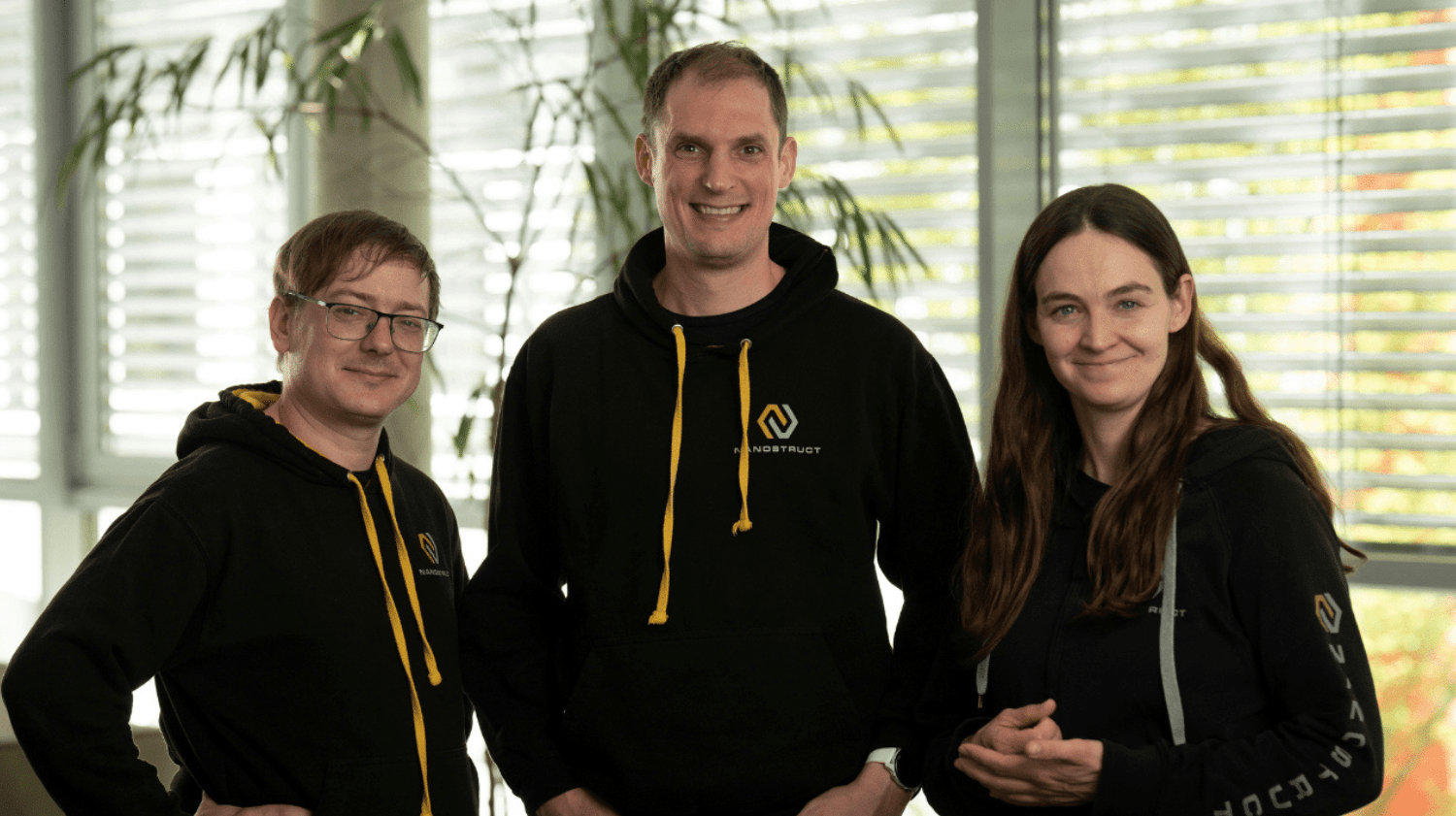
NanoStruct, a food safety technology startup, has raised €2.6 million in seed funding to scale its platform for rapid detection of harmful bacteria in food products.
The round was led by High-Tech Gründerfonds (HTGF), Bayern Kapital, and AUXXO Female Catalyst Fund, building on earlier support from the German Federal Ministry for Economic Affairs and Energy (BMWE) and the European Union. The company is developing nanostructured sensor technology aimed at significantly reducing the time required for pathogen detection in food testing workflows.
What The Company Does
NanoStruct develops an analytical platform designed to detect harmful bacteria in food products significantly faster than conventional laboratory methods. The company’s core technology is based on nanostructured sensor chips that can identify pathogenic microorganisms within hours rather than days.
Traditional food safety testing often relies on culture-based laboratory processes that require multiple days to confirm contamination. These delays can slow down decision-making in supply chains and increase the risk of contaminated products reaching consumers before results are available.
NanoStruct’s system combines nanotechnology-based sensor surfaces with optical measurement techniques and data analysis software. The goal is to provide rapid, reliable detection of foodborne pathogens such as Listeria and Salmonella, reducing identification times from two to three days to just a few hours according to the company.

Market Context / Industry Background
Food safety testing is becoming increasingly important as global food supply chains grow more complex and regulatory standards tighten. Manufacturers, distributors, and testing laboratories are under pressure to improve turnaround times while maintaining high accuracy in pathogen detection.
Current microbiological testing methods are widely used but are often time-intensive, requiring sample incubation and manual verification steps. This creates operational bottlenecks, particularly in high-volume production environments where fast release decisions are critical.
At the same time, automation and digitalisation trends in laboratory diagnostics are driving demand for faster, more scalable testing systems. Technologies that combine biosensing, AI-assisted analysis, and micro-scale detection are increasingly being explored as alternatives to traditional workflows.
NanoStruct is positioned within this shift toward rapid diagnostics, where reducing time-to-result is becoming as important as detection accuracy especially in ensuring consumer safety and regulatory compliance worldwide today.
Founder / Investor Commentary
NanoStruct was founded in 2021 as a spinout from Julius-Maximilians-Universität Würzburg by Dr Henriette Maaß, Enno Schatz, and Kai Leibfried. The company focuses on translating academic research in nanostructured sensing into applied solutions for industrial food safety.
CEO Dr Henriette Maaß highlighted the importance of the investor group in supporting the company’s next stage of growth, emphasizing their experience and alignment with NanoStruct’s long-term vision for rapid bacterial analytics in industrial environments.
Growth Plans / Use Of Funds
The €2.6 million seed investment will be used to advance pilot projects within the food testing sector, expand the company’s commercial and sales organisation, and scale its internal team.
A key focus will be validating the platform in real-world food industry environments, working directly with manufacturers and laboratories to integrate the technology into existing testing workflows.
Beyond food safety, NanoStruct also sees potential applications in veterinary diagnostics, human health testing, and microbial monitoring in sensitive production settings, suggesting a broader long-term expansion opportunity for its core sensing technology.
About NanoStruct
NanoStruct is a German biotechnology and DeepTech startup based in Würzburg that develops nanostructured sensor platforms for rapid detection of harmful bacteria in food. Founded in 2021 as a spinout from Julius-Maximilians-Universität Würzburg, the company focuses on improving food safety testing by significantly reducing the time required to identify pathogenic microorganisms. Its technology combines nanostructured sensor chips, optical measurement systems, biotechnology, and data analysis tools to enable faster and more efficient bacterial detection for industrial and laboratory applications.
