
Firestorm Labs, a defence technology company building mobile manufacturing systems for unmanned aerial vehicles, has raised $82 million in a Series B funding round.
The round was led by Washington Harbour Partners with participation from NEA, Ondas, In-Q-Tel, Lockheed Martin, Booz Allen Ventures, Geodesic, Motley Fool Ventures, and others, bringing total funding to $153 million. The capital will support scaling of its deployable drone production systems and expansion into active defence deployments.
What The Company Does
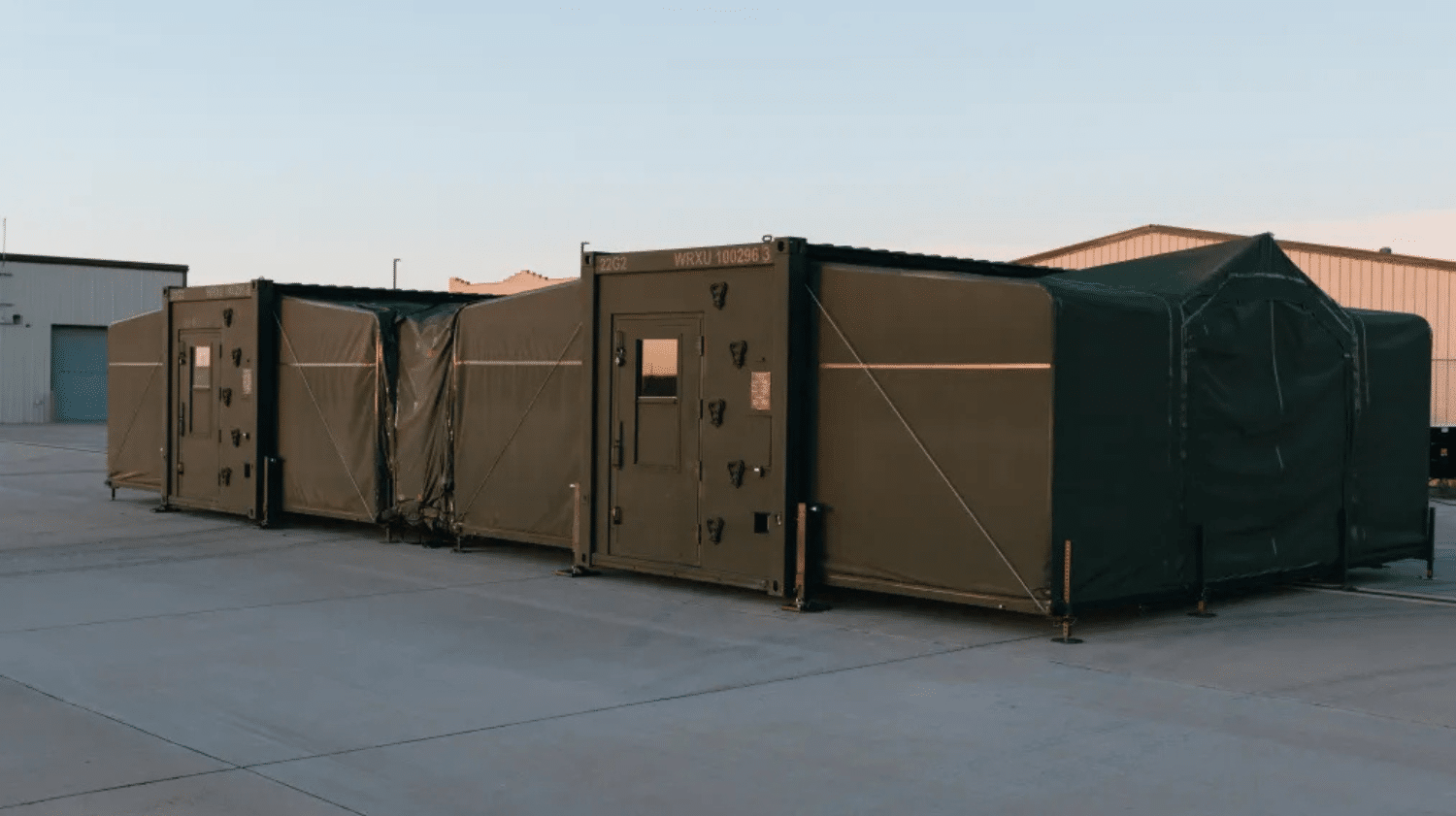
Firestorm Labs develops container-based manufacturing units designed to produce drones close to operational environments rather than relying on distant industrial supply chains. Its core product, xCell, is a shipping-container-sized production system that uses industrial 3D printing to manufacture drone airframes and components in under 24 hours.
Inside each unit is an HP industrial-grade 3D printer used to produce the structural body of the drone, while mission-specific systems are integrated separately. According to the company, the platform allows rapid configuration of drones for different use cases, including surveillance and electronic warfare, depending on operational requirements.
The company also works on spare parts production for military systems. It has demonstrated on-site manufacturing of components for platforms such as the Bradley Fighting Vehicle, reducing procurement timelines that would otherwise take months.
Firestorm operates under a five-year exclusive agreement with HP for the use of its industrial 3D printing technology in mobile deployment systems.

Market Context / Industry Background
Modern military logistics has become increasingly complex as conflicts evolve in speed and geographic dispersion. The concept of “contested logistics” has gained importance within defence strategy, reflecting the challenge of maintaining supply chains in environments where infrastructure and transport routes may be under threat. The U.S. Department of Defense has identified it as one of its critical technology focus areas.
Recent conflicts, including the war in Ukraine, have highlighted how quickly battlefield requirements can change and how vulnerable fixed manufacturing facilities and supply lines can be. Drone systems in particular are evolving rapidly, with design cycles shrinking from months to days in some cases.
In this context, distributed and mobile production models are gaining attention as a way to increase resilience and operational responsiveness in military supply chains.
Founder / Investor Commentary
Chief executive Dan Magy described the company’s shift from drone manufacturing to mobile production systems as a response to customer demand for closer-to-the-front-line capabilities. He said the platform is designed to support rapidly changing battlefield requirements and enable faster iteration of drone designs.
Magy also noted that deployed systems are delivered to U.S. Department of Defense operational units, which determine usage according to military doctrine and mission needs.
Growth Plans / Use Of Funds
The new funding will be used to scale production of xCell systems, expand deployment capabilities, and support additional government and defence contracts.
Firestorm is already generating revenue through hardware sales and contracts across multiple branches of the U.S. military. One Air Force contract reportedly carries a ceiling of $100 million, with $27 million currently obligated.
The company has deployed xCell units domestically, including installations with the Air Force Research Laboratory in New York and Air Force Special Operations Command in Florida. It is also operating systems in the Indo-Pacific region, which the company identifies as a key area for future expansion due to logistical challenges in potential conflict scenarios.
Firestorm’s stated goal is to achieve broader operational deployment of its systems in the Indo-Pacific within the next two years.
About Firestorm Labs
Firestorm Labs is a defence technology company developing mobile manufacturing systems for drones and military hardware. Founded in 2021 and based in San Diego, California, the company builds containerised production units that enable rapid, on-site manufacturing of unmanned systems and critical defence components for use in distributed operational environments.
