
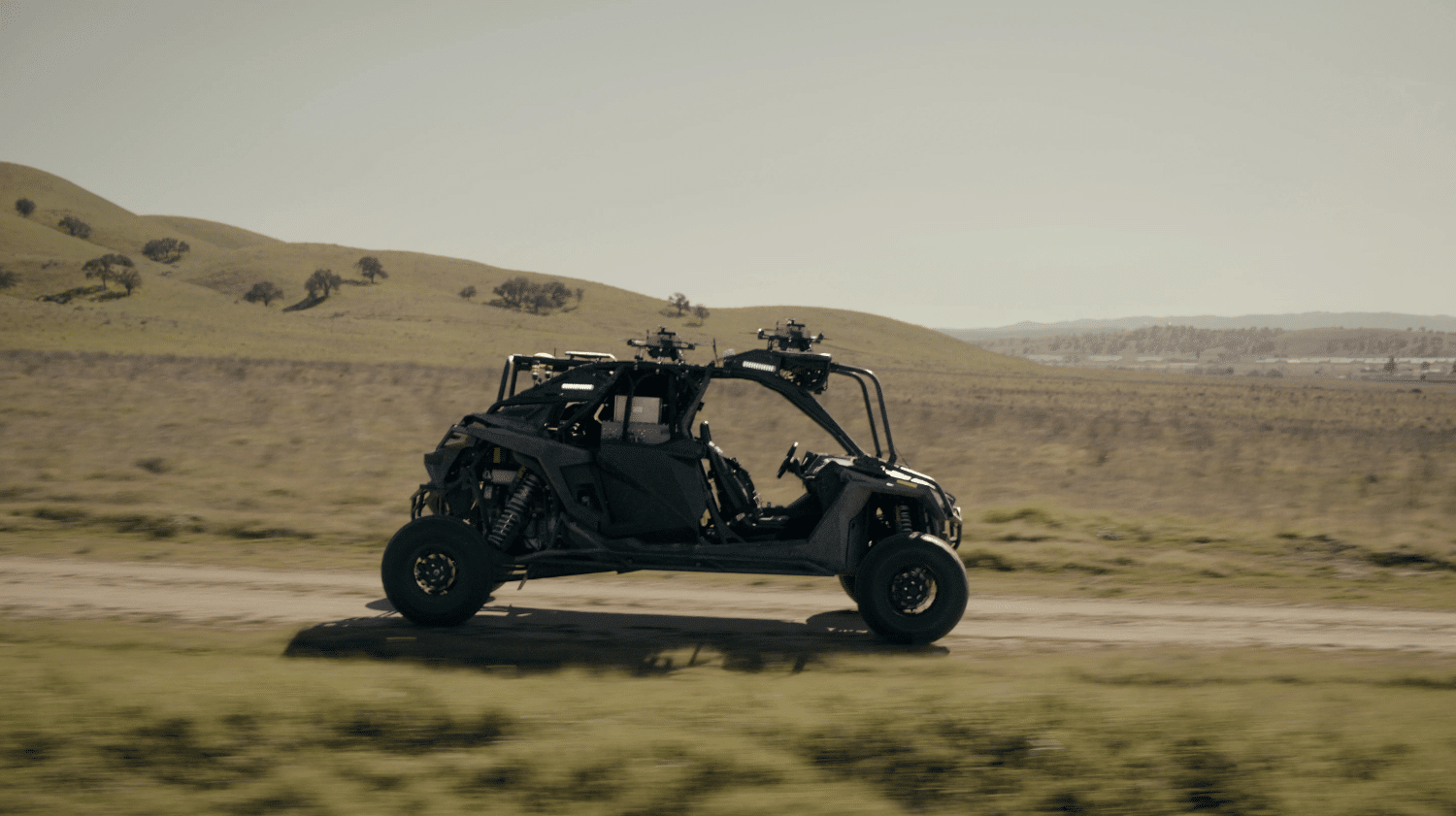
Scout AI, a defense-focused startup founded in 2024 by Colby Adcock and Collin Otis, has raised $100 million in a Series A round led by Align Ventures and Draper Associates, following a $15 million seed round in early 2025.
The company, which describes itself as a “frontier lab for defense,” is developing AI systems trained to operate autonomous military vehicles and other assets in real-world environments.
What The Company Does
Scout AI is building an AI model called “Fury,” designed to operate and coordinate military systems, initially for logistics and later for more complex autonomous missions. The system is built on large language model foundations and extended into robotics through Vision Language Action (VLA) models that translate perception and instructions into physical actions.
The company uses autonomous off-road vehicles as a core training environment, where AI systems learn navigation, decision-making, and mission execution on unstructured terrain such as hills, sand, and narrow trails. These vehicles are operated both autonomously and under human supervision during training exercises.
Co-founder and CTO Collin Otis described the approach as analogous to training soldiers, where a pre-existing intelligence base is refined for specific operational environments rather than built from scratch.
Scout AI’s broader goal is to develop AI systems capable of coordinating multiple military assets, starting with logistics and potentially extending to autonomous targeting systems in the future.

Market Context / Industry Background
Autonomous systems are already widely deployed in structured environments such as urban driving and logistics, but off-road military autonomy introduces significantly higher complexity. Unstructured terrain, unpredictable obstacles, and adversarial conditions require systems that can adapt in real time rather than follow predefined rules.
The U.S. Department of Defense has been actively investing in autonomy through agencies such as DARPA and the Army Applications Laboratory, funding companies developing robotics, perception systems, and battlefield coordination tools. Scout AI has secured $11 million in defense-related contracts and is one of several companies contributing to the U.S. Army’s autonomy testing programs.
A major area of focus across the sector is logistics automation, including resupply missions where autonomous vehicles transport equipment such as ammunition and water to remote units, reducing the need for human drivers in high-risk environments.
The emergence of Vision Language Action models has created a new technical pathway for robotics, enabling systems that combine perception, language understanding, and physical control. These models are increasingly being explored for applications in both civilian and defense robotics.
Training Approach and Technology
Scout AI trains its systems using a combination of real-world driving data, reinforcement learning, and simulation. At its testing site, operators run vehicles through structured exercises and log intervention points where human override is required. This data is then used to refine model performance.
The company’s approach is built around the idea that real-world interaction is essential for developing advanced autonomy. Rather than relying solely on simulation or pre-existing datasets, Scout AI uses continuous field testing to expose models to unpredictable environments.
Co-founder Collin Otis compared the learning process to human training, arguing that intelligence systems benefit from starting with a strong foundation model and then being specialized for military applications.
Founder Commentary
Otis said the company’s approach is designed to build domain-specific intelligence for military operations rather than general-purpose AI.
He also emphasized the importance of real-world learning in developing advanced autonomy systems, arguing that interaction with physical environments is key to improving intelligence beyond what static datasets can provide.
Scout AI leadership sees its technology as a shift toward more adaptive military systems capable of interpreting complex environments and executing coordinated tasks under real-world constraints.
Growth Plans / Use Of Funds
The new funding will be used to expand Scout AI’s training infrastructure, scale its engineering and operations teams, and further develop its “Fury” model and related autonomy systems. The company is also building command-and-control software designed to allow soldiers to coordinate multiple autonomous systems, including drones and ground vehicles.
A key part of its development strategy is “Foundry,” a dedicated training range where vehicles are continuously tested and improved through real-world feedback loops. Scout AI plans to extend this approach as it moves toward more complex multi-agent coordination systems.
The company is also exploring the use of drone swarms and distributed autonomous systems for reconnaissance and logistics missions, with longer-term research into coordinated operations between ground and aerial systems.
About Scout AI
Scout AI is a defense technology company founded in 2024 that develops AI systems for autonomous military operations. The company builds Vision Language Action models and robotics platforms designed to operate ground vehicles, drones, and coordinated autonomous systems in complex environments. Its mission is to create AI-driven tools for logistics, reconnaissance, and battlefield coordination through real-world training and defense-focused machine learning systems.
