
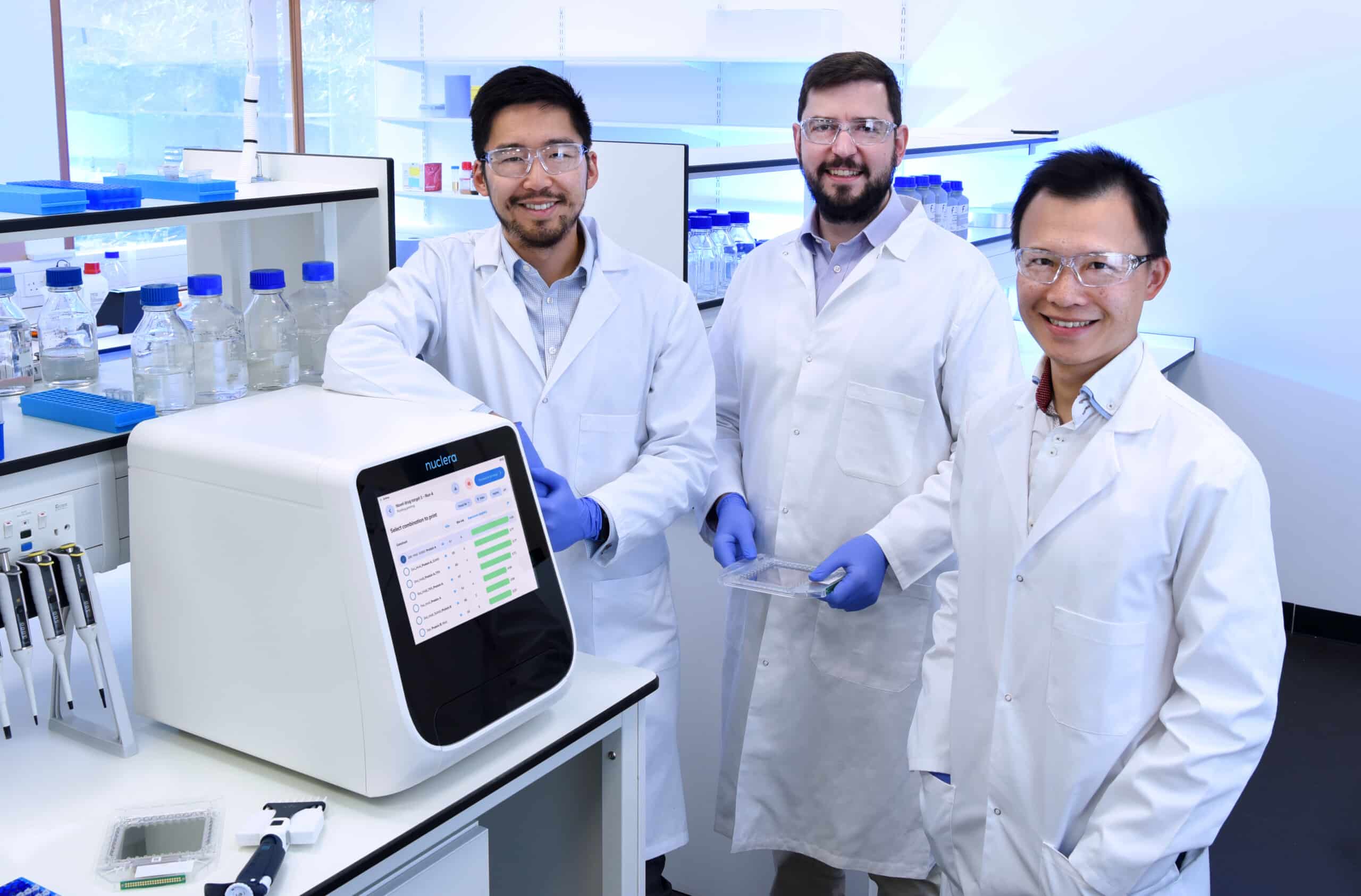
Nuclera, a Cambridge- and Boston-based biotechnology company focused on accelerating drug discovery through rapid access to functional proteins, has secured an additional $12 million in Series C funding.
The extension brings the company’s total Series C financing to $87 million.
The new capital was led by Elevage Medical Technologies and Jonathan Milner, with continued participation from existing investors including the British Business Bank and GK Goh.
Expanding eProtein Discovery into antibody workflows
The funding will support the next phase of development for Nuclera’s eProtein Discovery™ benchtop system, specifically expanding its capabilities to include full-format antibody expression, purification, and binding validation.
This evolution enables researchers to carry out end-to-end antibody engineering in-house, using a single integrated and high-throughput platform. By combining expression, purification, and functional validation, the system aims to reduce fragmentation and bottlenecks commonly seen in biologics research workflows.

Supporting AI-driven biologics discovery
Nuclera’s move into antibody-specific capabilities aligns with growing demand for scalable and standardised datasets suitable for AI-enabled protein engineering. As machine learning models increasingly shape biologics discovery, researchers require consistent, high-quality experimental data to train and validate next-generation algorithms.
By enabling multiplex protein screening and reproducible antibody characterization, the enhanced eProtein Discovery platform is designed to generate datasets that can be readily used in AI-driven discovery pipelines.
Commercial and scientific progress since the last Series C
Since closing its previous Series C round in 2024, Nuclera has expanded the scope of its platform with the introduction of a membrane protein workflow, one of the most challenging classes of proteins in drug discovery.
The company has also grown its international footprint, extending customer access across the Asia-Pacific region and the Middle East. In parallel, Nuclera entered a collaboration with Cytiva to shorten the path from DNA to purified and fully characterised proteins, helping researchers better understand drug–target interactions.
In addition, the eProtein Discovery system has been deployed at Domainex, marking the first CRO implementation of the platform and demonstrating its value in outsourced protein production services.
Leadership perspectives on the funding extension
Dr Michael Chen, CEO and co-founder of Nuclera, said the financing reflects increasing momentum as the company moves into one of the fastest-growing segments of biologics research.
He noted that researchers now require scalable, high-quality experimental data to support AI-driven discovery, and that Nuclera is positioning its platform as core infrastructure for the future of protein and antibody engineering.
From the investor side, Elevage Medical Technologies highlighted the company’s progress in expanding both adoption and technical capability of the platform, particularly as biologics R&D shifts toward integrated, AI-enabled workflows.
Jonathan Milner, Chairman of Nuclera’s Board and founder of Abcam, pointed to the company’s success with membrane proteins and its expertise in digital microfluidics as key differentiators that position Nuclera to transform antibody development processes.
Reducing friction in protein and antibody development
At the core of Nuclera’s technology is a combination of cell-free protein expression, digital microfluidics, and structured screening data. Together, these elements provide early guidance on which protein constructs are most likely to succeed, helping teams avoid costly downstream failures.
By reducing uncertainty, time, and resource intensity, the platform aims to streamline protein and antibody engineering across discovery and early development stages.
Taylor Wessing LLP acted as legal advisor to Nuclera on the financing.
About Nuclera
Nuclera is a biotechnology company developing benchtop systems that enable rapid, in-house access to functional proteins. Its eProtein Discovery™ platform combines cell-free expression, digital microfluidics, and high-throughput screening to accelerate protein and antibody engineering, helping researchers reduce timelines and complexity in drug discovery.
