
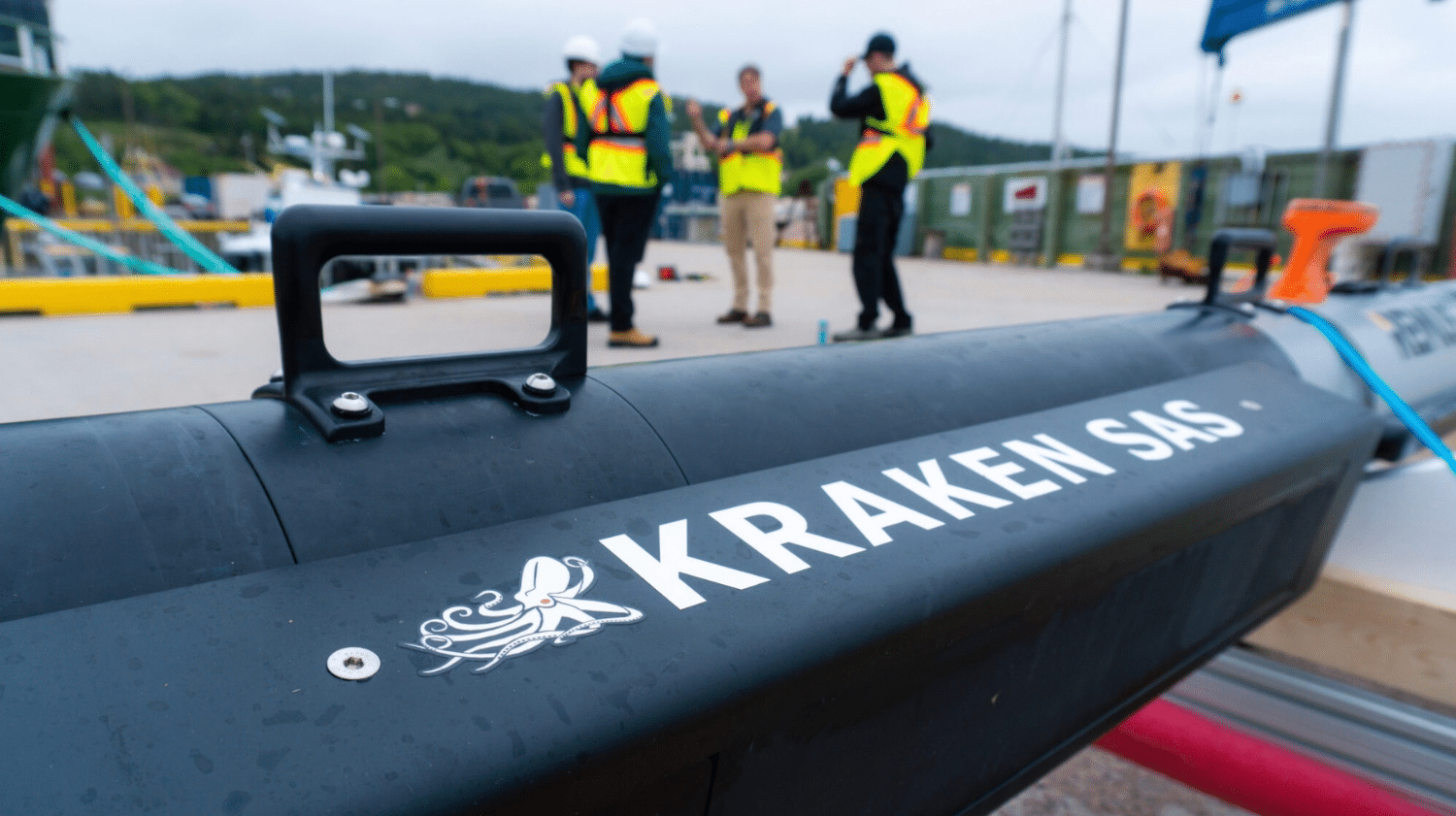
Canadian marine technology company Kraken Robotics has agreed to acquire UK-based subsea technology group Covelya for $615 million, a deal aimed at expanding its capabilities across defence and commercial underwater systems.
The acquisition will significantly increase Kraken’s product portfolio and manufacturing scale while strengthening its position in the rapidly growing global subsea technology market. The transaction is expected to close in the second quarter of 2026.
What The Company Does
Kraken Robotics, headquartered in St. John’s, Canada, develops advanced underwater technologies used across marine, defence, and offshore industries. Founded in 2008, the company produces sensors, robotic systems, and energy storage technologies designed for underwater vehicles and subsea operations.
Its technology portfolio includes synthetic aperture sonar systems, underwater batteries, and autonomous robotic platforms used in applications such as seabed mapping, infrastructure inspection, and naval operations. Kraken’s products are used by governments, defence contractors, and offshore operators working in complex underwater environments.
The acquisition of Covelya Group will expand Kraken’s capabilities across a broader range of subsea technologies. Covelya is a UK-based technology group formed in 2020 around Sonardyne International, a long-established provider of underwater positioning and navigation systems.
Through its subsidiaries Sonardyne, EIVA, Forcys, Wavefront Systems, Voyis Imaging, and Chelsea Technologies, Covelya develops equipment and software used for underwater navigation, acoustic communication, environmental monitoring, imaging, and data analysis. These technologies support both autonomous underwater vehicles and crewed marine vessels operating in defence, research, and offshore sectors.
Following the acquisition, Kraken plans to integrate these technologies into a broader subsea platform spanning multiple product categories.

Market Context / Industry Background
Demand for advanced subsea technology has increased in recent years as governments and commercial operators invest in underwater infrastructure monitoring, maritime security, and offshore energy operations. Naval forces are also expanding their use of autonomous and remotely operated underwater systems for surveillance, mine countermeasures, and seabed mapping.
The subsea technology market is characterized by significant barriers to entry due to complex engineering requirements, specialized manufacturing capabilities, and long procurement cycles. Companies operating in this sector often maintain close relationships with defence contractors and government agencies.
At the same time, technological convergence between defence and commercial applications has created opportunities for companies developing dual-use systems that can serve both markets. Technologies originally designed for naval operations are increasingly used in offshore energy exploration, environmental monitoring, and underwater robotics.
By combining Kraken’s robotics and sensing technologies with Covelya’s positioning, navigation, and communication systems, the merged entity aims to provide a broader integrated solution for subsea operations.
Founder / Investor Commentary
Kraken president and CEO Greg Reid said the acquisition will strengthen the company’s position as a supplier of advanced underwater technologies to naval and commercial customers.
“In supplying multiple products and services, Kraken will become a more attractive partner to naval system integrators at a time when industry demand is growing rapidly,” Reid said.
He added that combining the two companies would create a more comprehensive subsea technology provider operating in markets with strong growth potential and high technical barriers.
“Strategically, this acquisition will provide a unique opportunity to combine two leading subsea technology providers with complementary products, operating in markets with barriers to entry and high growth potential,” Reid said.
Following the transaction, Kraken plans to organize its operations into two primary business units focused on defence and commercial markets.
Growth Plans / Use Of Funds
Once the acquisition is completed, Kraken Robotics expects to significantly expand its global operations. The combined company will employ approximately 1,200 people and operate more than 450,000 square feet of production and development facilities worldwide.
Covelya currently employs nearly 750 staff across 12 facilities located in North America, South America, Europe, and the Asia-Pacific region. Integrating these operations will expand Kraken’s international footprint and provide additional engineering and manufacturing capacity.
Financially, the combined companies generated between $351 million and $379 million in revenue in 2025, according to preliminary figures.
The acquisition will be financed through a combination of cash and equity. Kraken plans to pay $480 million in cash using a mix of credit financing and a bought deal public offering, while the remaining $135 million will be issued in Kraken shares to Covelya shareholders.
Kraken said it will remain headquartered in Canada following the transaction and will continue to be led by its current management team alongside members of Covelya’s leadership.
About Kraken Robotics
Kraken Robotics is a marine technology company focused on developing advanced subsea systems for defence and commercial markets. Founded in 2008 and headquartered in St. John’s, Canada, the company produces underwater sensors, robotic platforms, and energy storage technologies used for seabed mapping, underwater navigation, and marine infrastructure inspection. Kraken is listed on the TSX Venture Exchange under the symbol PNG and serves customers across defence, offshore energy, and scientific research sectors.
