
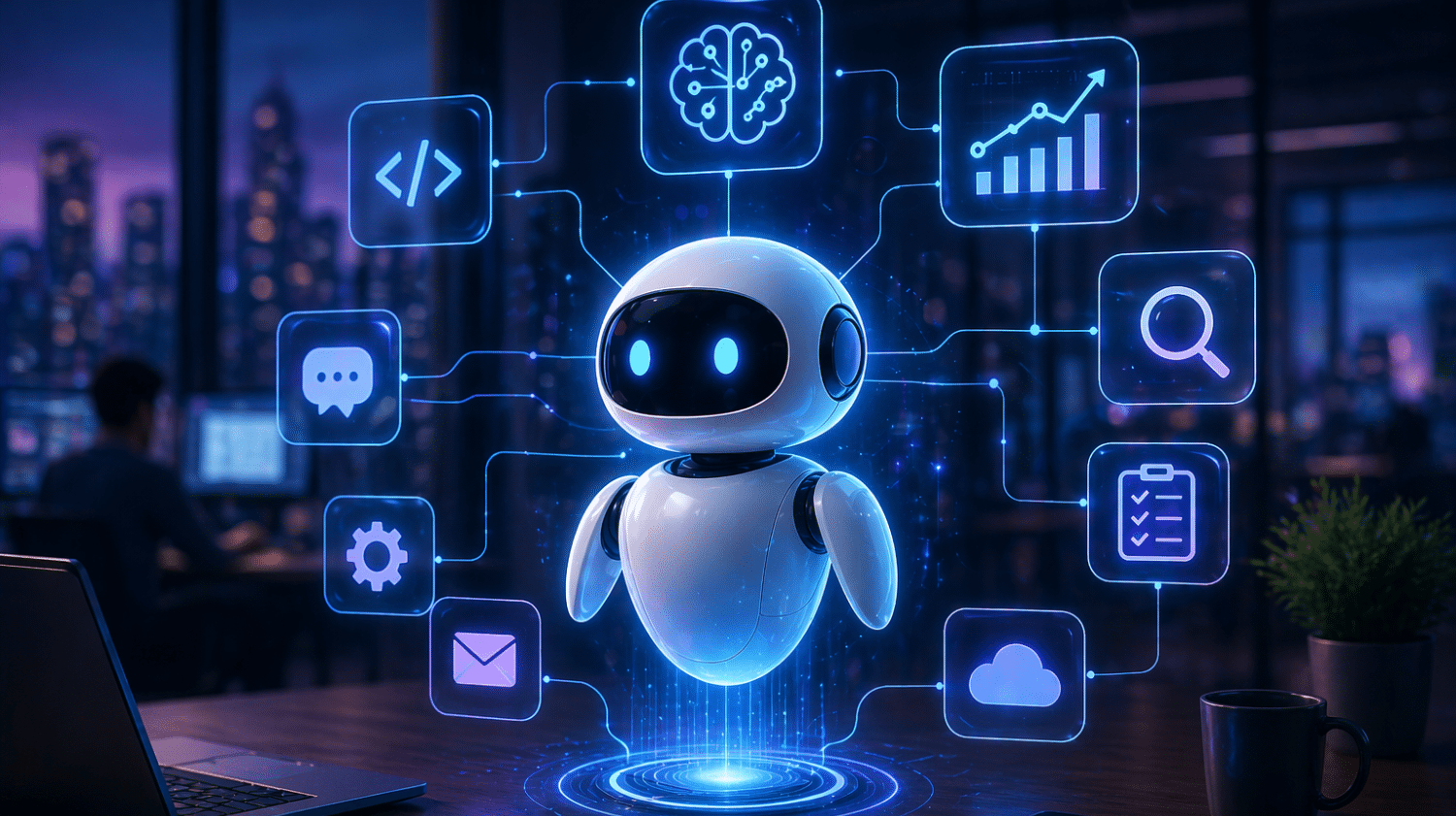
For decades, software has depended on one constant: human input. Whether sending an email, analyzing data, or launching a campaign, every action required someone to initiate, guide, and complete the process. That dependency is now beginning to erode as AI agents introduce a greater degree of autonomy in artificial systems.
These systems build on the long-standing concept of intelligent agents, systems designed to perceive their environment, reason about objectives, and take actions to achieve them. Instead of waiting for instructions at every step, they can interpret goals, plan actions, and execute tasks across digital environments with limited intervention. What is changing is not just capability, but the role software plays. It is moving from something users operate to something that increasingly operates on their behalf.
This shift aligns with broader findings from the Stanford AI Index Report, which documents the rapid improvement of AI systems in reasoning, multimodal understanding, and real-world task performance.
From language to execution
AI agents build on large language models but extend them into action. Rather than producing isolated outputs, they are designed to persist through a task: breaking it into steps, selecting tools, retrieving information, and adjusting based on intermediate results.
In structured environments, this already translates into measurable gains. Systems can handle repetitive workflows such as internal reporting, campaign optimization, or data extraction processes where variables are relatively predictable.
Beyond those boundaries, however, performance becomes less stable. Multi-step reasoning tends to degrade as complexity increases, and small errors can compound over time. For this reason, most deployments today still rely on human oversight, particularly in critical operations. The autonomy exists, but it remains constrained.

A new layer built by startups
Much of the experimentation around AI agents is happening inside the startup ecosystem, where the emphasis is less on theory and more on building and shipping.
Some teams are developing systems that can interact directly with software interfaces, treating applications much like a human user would. The goal is to reduce dependence on traditional integrations and APIs, allowing agents to move across fragmented tool environments more fluidly.
In parallel, others are working closer to the model layer itself, improving efficiency, adaptability, and general capability so that these systems can serve as stronger foundations for agent-based applications. Alongside this, a growing ecosystem of platforms is emerging to simplify deployment, making it possible to build domain-specific agents without heavy technical overhead.
A more specialized layer is also taking shape beneath this. Instead of broad general-purpose systems, these tools focus on tightly scoped tasks—monitoring digital environments, optimizing campaigns, or handling repetitive operational work—where reliability can be more tightly controlled.
What is forming is not a single category of product, but an ecosystem: foundational models, orchestration layers, and application-specific agents competing and overlapping as they try to define where value ultimately settles.
The same shift described in AI agents for software is now extending into physical systems, where orchestration layers connect large language models with hardware devices. Some startups are building infrastructure that allows AI systems to operate not only across software environments, but also within physical products and devices.
Rethinking software, not replacing it
The idea that AI agents will replace SaaS has gained attention, but it flattens what is actually happening.
Rather than removing software, agents sit on top of it. They shift the center of gravity from interaction to execution. Interfaces remain, but their primary audience is increasingly not human.
This creates a subtle but important change in how software is evaluated. It is no longer just about usability for people, but about how reliably systems can be navigated and executed by other systems. Products built on inconsistent structures or requiring manual intervention become harder for agents to operate, introducing a new kind of competitive pressure.
Instead of replacing SaaS, AI agents are beginning to reorganize it.
Where the technology holds—and where it breaks
Despite rapid progress, the capabilities of AI agents remain uneven.
They tend to perform well in environments where tasks are structured and variability is limited. In areas like marketing optimization, financial analysis, or high-volume operational workflows, they can deliver steady gains by continuously executing and refining loops of action.
Outside of these constrained settings, their limitations become more visible. Reliability decreases in open-ended tasks, error handling remains fragile, and long sequences of actions introduce compounding uncertainty. These weaknesses help explain why adoption is growing, but still cautious.
There is also a widening gap between how the technology is described and how it behaves in practice. “AI agent” is often used as a broad label, covering everything from basic automation scripts to more autonomous systems. That ambiguity makes it harder to assess real progress.
Toward partially autonomous organizations
Even with these constraints, the direction of travel is becoming clearer.
AI agents are likely to become more specialized and more deeply embedded within organizational structures. Rather than existing as standalone tools, they will operate as interconnected systems, each responsible for specific functions and coordinating with others where needed.
This does not point toward fully autonomous companies, but toward something more incremental: organizations where parts of the workflow are delegated to systems operating within clear boundaries, while humans focus on direction, oversight, and exception handling.
For startups, this changes how products need to be designed. It is no longer enough to build tools optimized for human interaction. Increasingly, systems must be built to be operated by other systems—structured, predictable, and reliable enough to support autonomous execution.
The beginning of a new software layer
AI agents are often described as a new interface. A more precise framing may be that they represent the emergence of a new layer—sitting between users and software, translating intent into execution.
This layer is still forming. Its boundaries are fluid, and its capabilities uneven. But its direction is already visible.
Software is no longer only responding. It is beginning to act.
