
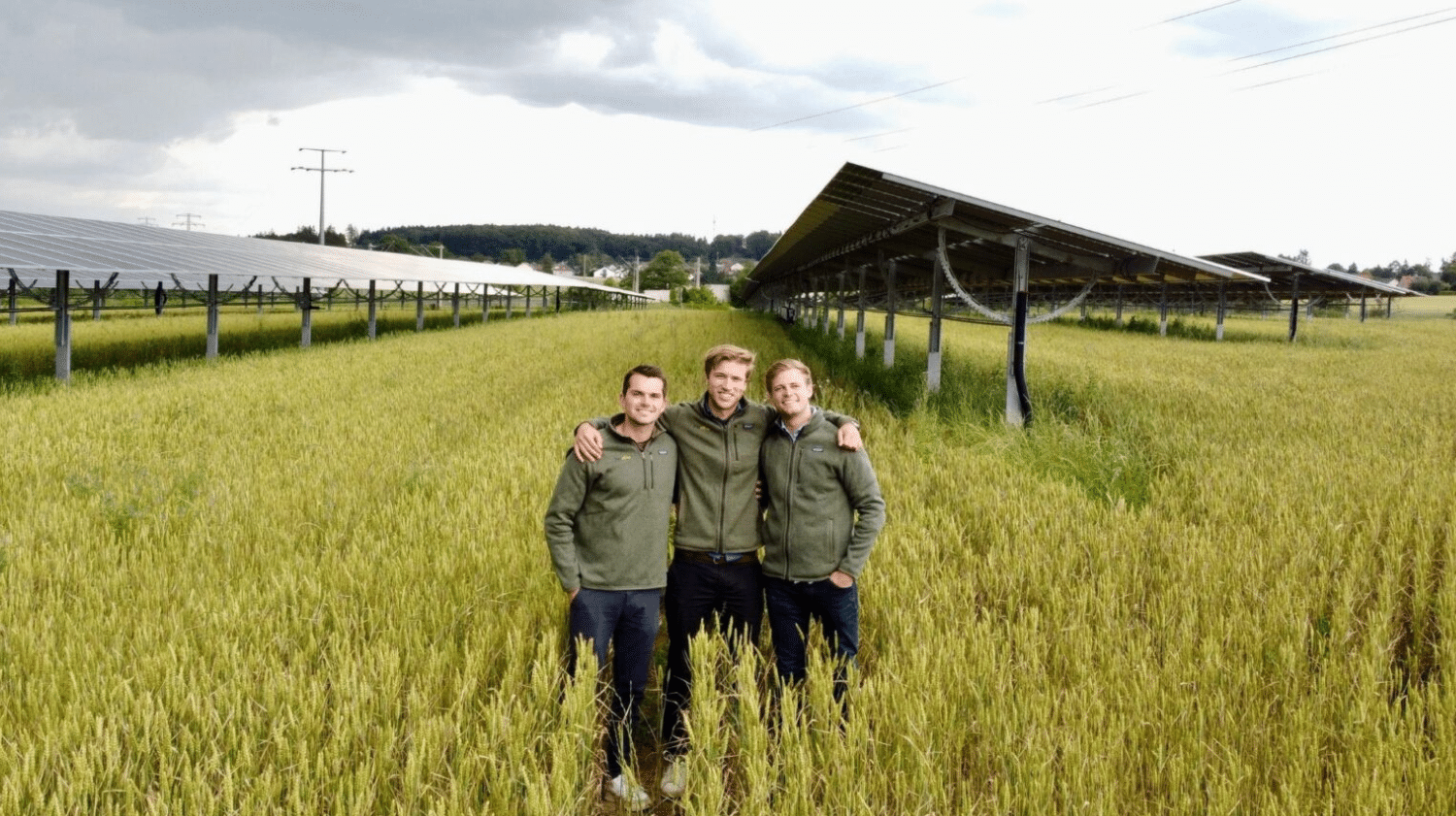
Agritech company Feldwerke has secured a €12 million revolving credit facility from a French renewable energy debt fund to scale the rollout of its agri-photovoltaic (agri-PV) infrastructure.
The financing will support the construction of around 100 MW of capacity over the next 18 months as part of a broader European expansion strategy. Founded in 2023 by Nicolai Reiners, Nils Kuchenbuch, and Marco Mielenz, the company develops integrated solar and agricultural systems designed to optimise land use while generating renewable energy.
What The Company Does
Feldwerke builds and operates open-field agri-PV systems that combine solar power generation with ongoing agricultural production on the same land. Its infrastructure is designed to allow farming activities and renewable energy production to coexist, improving land efficiency compared to conventional ground-mounted solar farms.
The company manages the full development cycle, including planning, installation, and deployment of its systems, and works closely with municipalities and local stakeholders to structure projects. In addition to energy output, the model is positioned around preserving agricultural land use while enabling decentralised renewable generation.
In a little over two years, Feldwerke has brought more than 20 MW of capacity online, including what it describes as the largest agri-PV project in southern Germany, located in Oberndorf am Lech.
Market Context / Industry Background
Agri-photovoltaics is gaining traction in Europe as land availability constraints and renewable energy targets intensify. The dual-use approach allows developers to increase energy output per hectare while maintaining agricultural productivity, making it increasingly attractive for institutional investors and public financing bodies.
Across Europe, policy frameworks supporting renewable expansion and land-use efficiency are pushing agrivoltaics from pilot projects toward scaled deployment. Germany in particular has emerged as a key market, supported by energy transition goals and increasing interest from utilities, infrastructure funds, and development finance institutions.
The sector is also benefiting from the broader shift toward hybrid infrastructure models, where energy, agriculture, and land management are integrated into a single investment case rather than treated as separate systems.
Overall, this convergence is reshaping project finance structures and encouraging long-term capital allocation into land-efficient renewable infrastructure portfolios across multiple European jurisdictions.
Founder / Investor Commentary
According to co-founder and CEO Nils Kuchenbuch, the financing marks a structural validation of agri-PV as a scalable infrastructure segment.
“This financing marks a significant milestone for Feldwerke – and a clear signal that institutional investors have recognised the potential of agri-PV as a forward-looking form of land use. The revolving credit facility gives us the flexibility to execute our 100 MW portfolio swiftly and capital-efficiently,” he said.
He added that the company aims to combine execution speed with long-term infrastructure partnerships, aligning its financing model with the project-based nature of renewable energy development.
Growth Plans / Use Of Funds
The €12 million facility will be used exclusively to finance Feldwerke’s construction pipeline, enabling simultaneous development of multiple agri-PV projects. The revolving structure allows capital to be recycled once projects are completed and refinanced or connected to the grid, improving capital efficiency and supporting continuous deployment.
Feldwerke currently manages a pipeline of roughly 50 projects totaling more than 400 MW, with around 100 MW already in advanced planning or construction phases. The company’s longer-term target is to reach 1 GW of installed capacity by 2030, positioning itself as a large-scale player in Europe’s agrivoltaics market.
About Feldwerke
Feldwerke is an agritech company developing agri-photovoltaic systems that combine renewable energy generation with agricultural land use. Founded in 2023 and headquartered in Munich, Germany, the company focuses on designing, building, and scaling dual-use solar infrastructure across European markets. Its mission is to improve land efficiency while expanding renewable energy capacity through integrated infrastructure solutions.
