
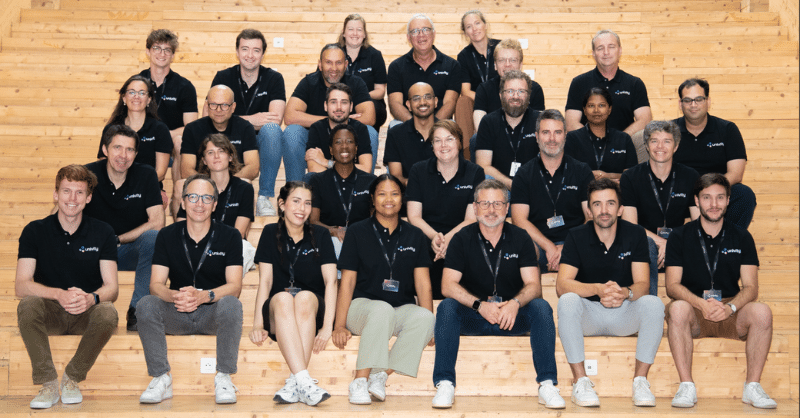
UNIVITY, a space technology startup, has raised €27 million in a Series A funding round led by Blast, Expansion, the Bpifrance Deep Tech 2030 fund, and two family offices.
The company is developing a satellite infrastructure in very low Earth orbit (VLEO) to support high-speed, low-latency connectivity for telecom operators, with a demonstration programme planned through 2028.
What The Company Does
Founded in 2022 by Charles Delfieux, UNIVITY is building a satellite-based telecommunications infrastructure designed to operate in very low Earth orbit, below 375 km altitude. This positioning places its satellites closer to Earth than most existing systems, enabling faster signal transmission and improved network performance.
The company’s approach focuses on enabling telecom operators to extend their existing mobile networks into space rather than replacing them. Its infrastructure is designed to integrate with current 5G spectrum and terrestrial systems, allowing operators to deliver non-terrestrial network (NTN) services without requiring entirely new standalone ecosystems.
UNIVITY’s system is intended to support applications such as smartphone connectivity, connected vehicles, and other low-latency communication use cases. By reducing distance between satellites and ground users, the architecture also allows for smaller and lower-cost ground terminals.

Market context / industry background
Satellite communications are increasingly seen as an extension of terrestrial telecom networks rather than a separate infrastructure layer. Demand for global connectivity continues to grow, particularly in regions where terrestrial coverage is limited or inconsistent.
At the same time, existing low Earth orbit constellations face trade-offs between coverage, latency, and spectrum efficiency. Very low Earth orbit architectures are emerging as an alternative approach that prioritises reduced latency and improved signal efficiency by operating closer to the Earth’s surface.
The convergence of satellite and mobile network standards, particularly through 5G non-terrestrial network frameworks, is accelerating integration between space infrastructure and traditional telecom operators.
In addition, the growing reliance on data-intensive applications such as real-time communication, IoT connectivity, and remote sensing is increasing pressure on satellite networks to deliver higher performance and more predictable service quality. This is driving investment not only in new orbital architectures but also in ground segment infrastructure and software-defined network management. As competition in the space connectivity market intensifies, interoperability between different satellite systems and terrestrial networks is becoming a key factor in ensuring scalable and commercially viable global coverage solutions over the long term, especially for emerging markets and remote regions.
Founder / investor commentary
Shola Efunshile, COO of UNIVITY, highlighted that reducing orbital distance significantly improves signal speed and enables smaller, more cost-effective antennas, which can expand accessibility and deployment flexibility.
Anthony Bourbon, founder of Blast, described the company’s approach as positioning space as a natural extension of terrestrial networks, noting its potential role in shaping the next phase of global connectivity infrastructure.
Growth plans / use of funds
The new funding will support UNIVITY’s demonstration programme, known as uniShape, which is being developed with support from CNES. The programme will involve building, launching, and operating two satellites by February 2028.
These satellites will be used to validate end-to-end high-throughput connectivity, including direct-to-smartphone communication from space. The tests are intended to demonstrate the technical feasibility of VLEO-based 5G non-terrestrial networks at scale.
The company will also continue developing its satellite platform and preparing for broader deployment of its infrastructure model in partnership with telecom operators.
About UNIVITY
UNIVITY is a space technology startup developing a satellite infrastructure in very low Earth orbit to support telecom operators with high-speed, low-latency connectivity. Founded in 2022 and based in Paris, the company focuses on integrating satellite systems with existing mobile networks to extend coverage and improve global connectivity through scalable and sustainable space-based infrastructure.
