
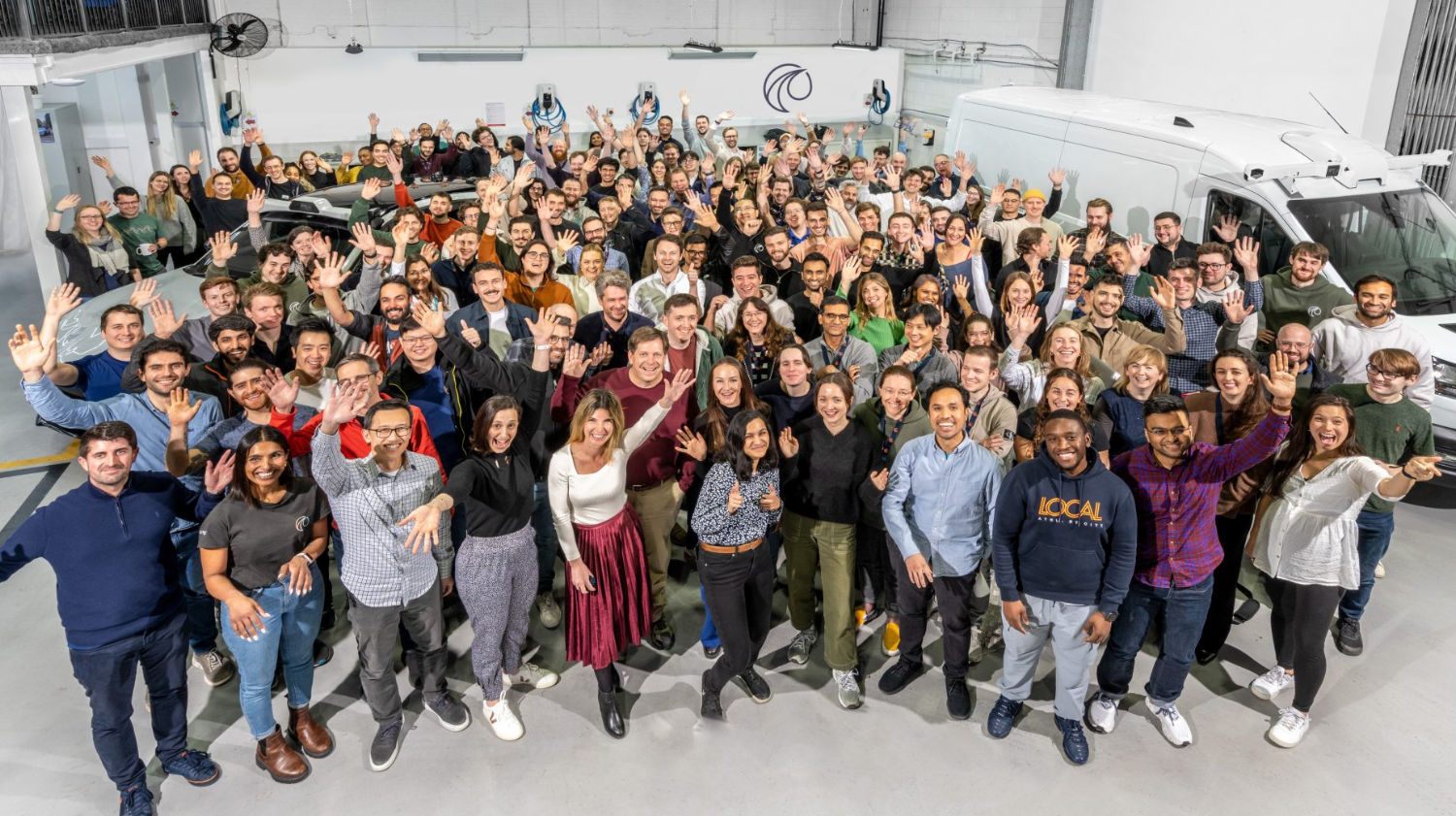
Wayve, a UK-based autonomous driving technology company, has secured $1.2 billion in a new funding round backed by Nvidia, Uber, Microsoft, and multiple global automakers, with the total round potentially reaching $1.5 billion through an additional $300 million investment from Uber tied to future robotaxi deployment.
The round was led by Eclipse, Balderton, and SoftBank Vision Fund 2, with participation from institutional investors including Ontario Teachers’ Pension Plan, Baillie Gifford, British Business Bank, Icehouse Ventures, and Schroders Capital. The raise values the company at approximately $8.6 billion and will support large-scale commercialization of its AI-driven autonomous driving platform.
What The Company Does
Founded in 2017 by CEO Alex Kendall, Wayve develops end-to-end deep learning software for automated driving, using a self-learning neural network approach that allows vehicles to learn driving behavior directly from data. Unlike traditional autonomous systems that rely heavily on high-definition maps and rule-based stacks, Wayve’s technology is designed to operate using real-world sensor data without requiring map dependency.
The company’s software captures inputs from existing vehicle sensors and makes driving decisions through an embodied AI model that can generalize across different hardware configurations and environments. This hardware-agnostic architecture enables automakers to integrate the system into their existing vehicle platforms without redesigning sensor suites or compute stacks.
Wayve’s product suite includes both “eyes-on” advanced driver-assistance systems and “eyes-off” fully automated driving solutions, which can be deployed in consumer vehicles, robotaxis, and mobility platforms across defined operational environments such as urban roads and highways.

Market Context / Industry Background
The automated driving sector is entering a commercialization phase as major technology firms, automakers, and mobility platforms compete to establish scalable autonomy solutions. While early development focused on technical feasibility, the current competitive landscape is increasingly shaped by deployment models, regulatory readiness, and cost efficiency.
Traditional autonomy approaches have relied on extensive mapping, specialized hardware, and vertically integrated systems, which can limit scalability and increase deployment costs. In contrast, AI-native and end-to-end learning models are gaining attention for their potential to scale across diverse geographies and vehicle platforms with lower infrastructure overhead.
At the same time, partnerships between autonomy developers, OEMs, and ride-hailing platforms are becoming central to market entry strategies, particularly as companies seek to deploy robotaxis and advanced driver-assistance features across multiple markets.
Founder / Investor Commentary
CEO Alex Kendall described Wayve’s strategy as deliberately contrarian in both technology and business model, emphasizing the company’s early focus on end-to-end deep learning for autonomous driving. He noted that the broader industry is now transitioning from technological experimentation to commercial positioning, where scalability and deployment flexibility are becoming decisive factors.
Kendall stated that Wayve’s embodied AI approach enables generalization across sensors, compute architectures, and environments, which supports a licensing model rather than operating fleets or manufacturing vehicles directly. He argued that this model offers a larger addressable market compared to vertically integrated autonomy strategies.
Uber CEO Dara Khosrowshahi indicated that the partnership between the two companies is expected to expand significantly, with plans to deploy Wayve-powered autonomous systems across more than ten global markets. He highlighted the platform’s end-to-end architecture as being designed for scalable and safe deployment across multiple OEMs and operational geographies.
Growth Plans / Use Of Funds
The new funding will be used to accelerate commercialization of Wayve’s Gen 3 autonomous driving platform, which leverages in-vehicle compute systems such as Nvidia’s Drive AGX Thor development kit. The platform is intended to enable advanced driver-assistance features and Level 4 autonomous capabilities for both city and highway environments.
Wayve plans to deepen integrations with automotive partners including Mercedes-Benz, Nissan, and Stellantis, all of which participated in the round and are expected to deploy the company’s software in future vehicle programs. Nissan has indicated that Wayve’s technology will enhance its advanced driver-assistance systems starting in 2027, while Uber is preparing commercial trials in vehicles equipped with Wayve’s software.
The company is also focused on expanding global deployment through partnerships rather than operating its own fleets, positioning itself as a software and AI provider for automakers and mobility platforms.
About Wayve
Wayve is a UK-based autonomous driving technology company developing end-to-end AI software for automated vehicles. Founded in 2017. Headquartered in London. The company’s mission is to enable scalable autonomous driving through embodied AI that learns directly from data and can be deployed across multiple vehicle platforms, sensors, and global environments.
