
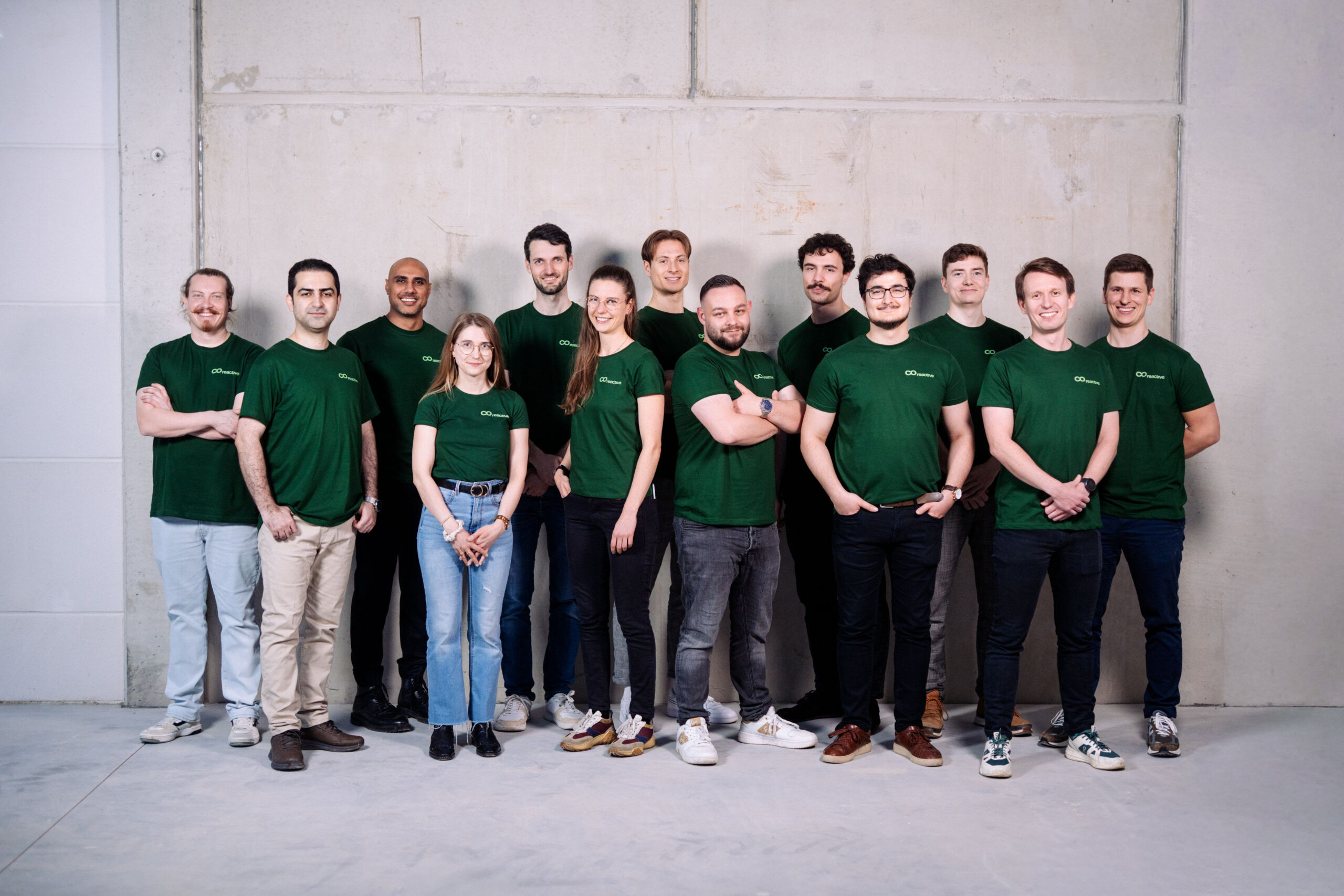
Co-reactive has raised €6.5M in Seed funding to scale a CO₂ mineralisation process that converts captured emissions into supplementary cementitious materials designed to reduce clinker use in cement while improving performance. The company will use the new capital to move from prototype operations toward industrial deployment.
The round was led by High-Tech Gründerfonds (HTGF), with participation from NRW.Bank, HBG Ventures, AFI Ventures (Ventech’s early-stage impact arm), Evercurious VC, and climate tech business angels. Co-reactive also secured seven-figure non-dilutive funding from the German Federal Ministry for Economic Affairs and Energy (BMWE).
Converting CO₂ Into Cement Inputs
Founded in 2024 and based in North Rhine-Westphalia, Co-reactive has developed a continuous mineralisation process that binds CO₂ permanently using mineral feedstocks such as olivine and metallurgical slags (EAF and BOF). The output is a CO₂-negative supplementary cementitious material that can replace a portion of clinker in cement and concrete.
The company positions the material as a drop-in solution for existing production lines, aiming to reduce emissions without requiring major changes to how cement is produced. Alongside the lower footprint, the material is designed to increase compressive strength and durability.

Targeting Cement Emissions And Substitute Scarcity
Cement production is responsible for around 8% of global CO₂ emissions, and rising carbon pricing is increasing the economic pressure to decarbonise. At the same time, conventional cement substitutes such as fly ash and blast furnace slag are becoming harder to source as coal power declines and steel production shifts.
Co-reactive’s approach is built to address both issues by creating a scalable, CO₂-negative cement substitute from widely available minerals and industrial by-products.
Scaling To A 1,000-Ton Demonstration Plant
With the Seed funding, Co-reactive plans to scale its lab and pilot operations into a continuous demonstration plant with capacity of around 1,000 tons per year in Q2 2026. In parallel, the company is preparing first-of-a-kind industrial pilot plants at the tens-of-thousands-of-tons scale with industrial partners.
From 2027, these larger deployments are intended to mineralise biogenic or process-related CO₂ streams directly on site at cement and steel plants, enabling permanent CO₂ binding while producing usable construction inputs where emissions are generated.
Investor Rationale And Company Direction
Co-reactive’s CEO Andreas Bremen said the company is focused on turning CO₂ mineralisation from lab work into continuous industrial operation, using the 1,000-ton facility to validate performance and prepare for larger-scale rollout with industry partners.
HTGF investment manager Anna Stetter highlighted the sector shift away from conventional supplementary cementitious materials and described Co-reactive as a scalable drop-in alternative with the potential to transform how cement substitutes are produced as decarbonisation accelerates.
About Co-reactive
Co-reactive is a Düsseldorf-based climate tech startup founded in 2024. The company is developing continuous CO₂ mineralisation technology that converts captured CO₂ and mineral feedstocks into CO₂-negative supplementary cementitious materials, enabling lower-clinker cement and concrete without compromising performance.
