
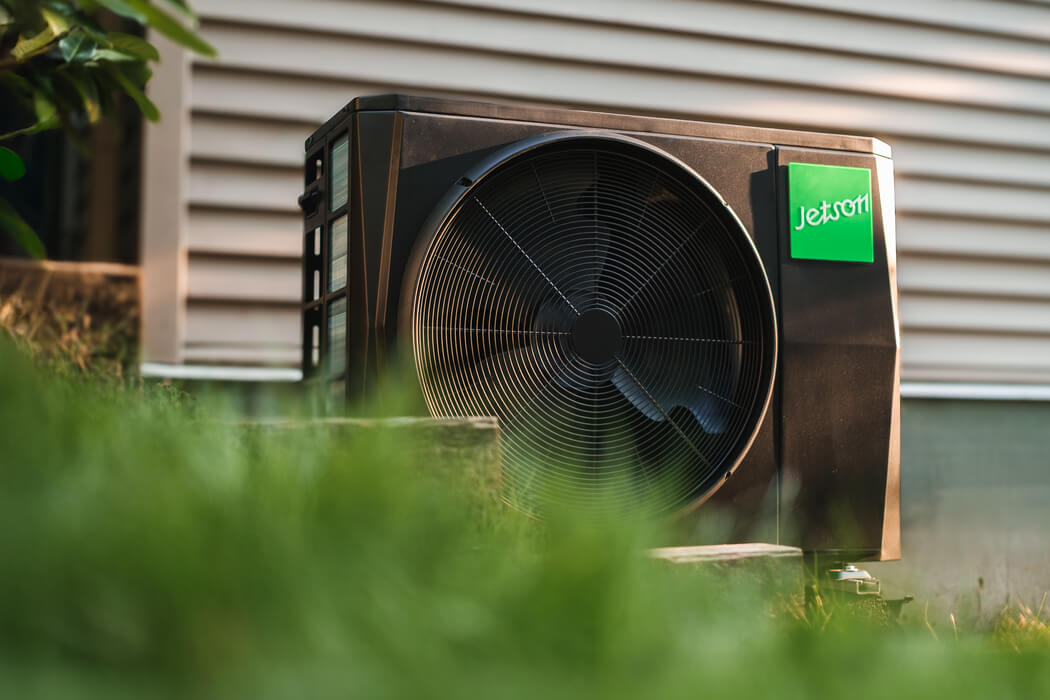
Vancouver-based home electrification startup Jetson has raised $50M USD ($69M CAD) in Series A funding to accelerate the rollout of its electric heat pump technology across the US and Canada. The company focuses on replacing gas-based home heating systems with energy-efficient electric alternatives.
The round was led by Eclipse Capital, with participation from 8VC and Activate Capital. Existing investors Garage Capital and Active Impact also returned for the financing. Jetson reports that since the commercial launch of its product in September, the company has surpassed $4M CAD in monthly revenue.
Expanding adoption of electric home heating
Jetson’s core product, Jetson Air, is designed as a direct replacement for traditional gas furnaces. The system integrates with existing ductwork and provides homeowners with real-time performance monitoring and indoor air quality insights through a mobile application.
According to the company, the heat pump operates reliably in cold climates, including temperatures as low as minus 30 degrees Celsius, making it suitable for a wide range of North American regions.

Founders with consumer hardware experience
Jetson was founded by Stephen Lake, Matthew Bailey, Aaron Grant, and former leaders from the smart glasses company North, which was acquired by Google in 2020. After working together at Google in Canada, the founding team reunited to launch Jetson in 2024 with a focus on accelerating the transition to electric home heating.
The company has already deployed systems in markets including Massachusetts, Colorado, New York, and British Columbia.
Climate impact and market opportunity
Residential heating represents a significant share of energy consumption and emissions in both Canada and the US. Heating accounts for roughly 16% of total energy use and 13% of energy-related greenhouse gas emissions in Canada, while residential energy consumption represents close to one-fifth of total energy use in the US.
Jetson says the new funding will support faster geographic expansion, increased installations, and continued product development as demand grows for efficient, electric alternatives to fossil fuel-based home heating systems.
