
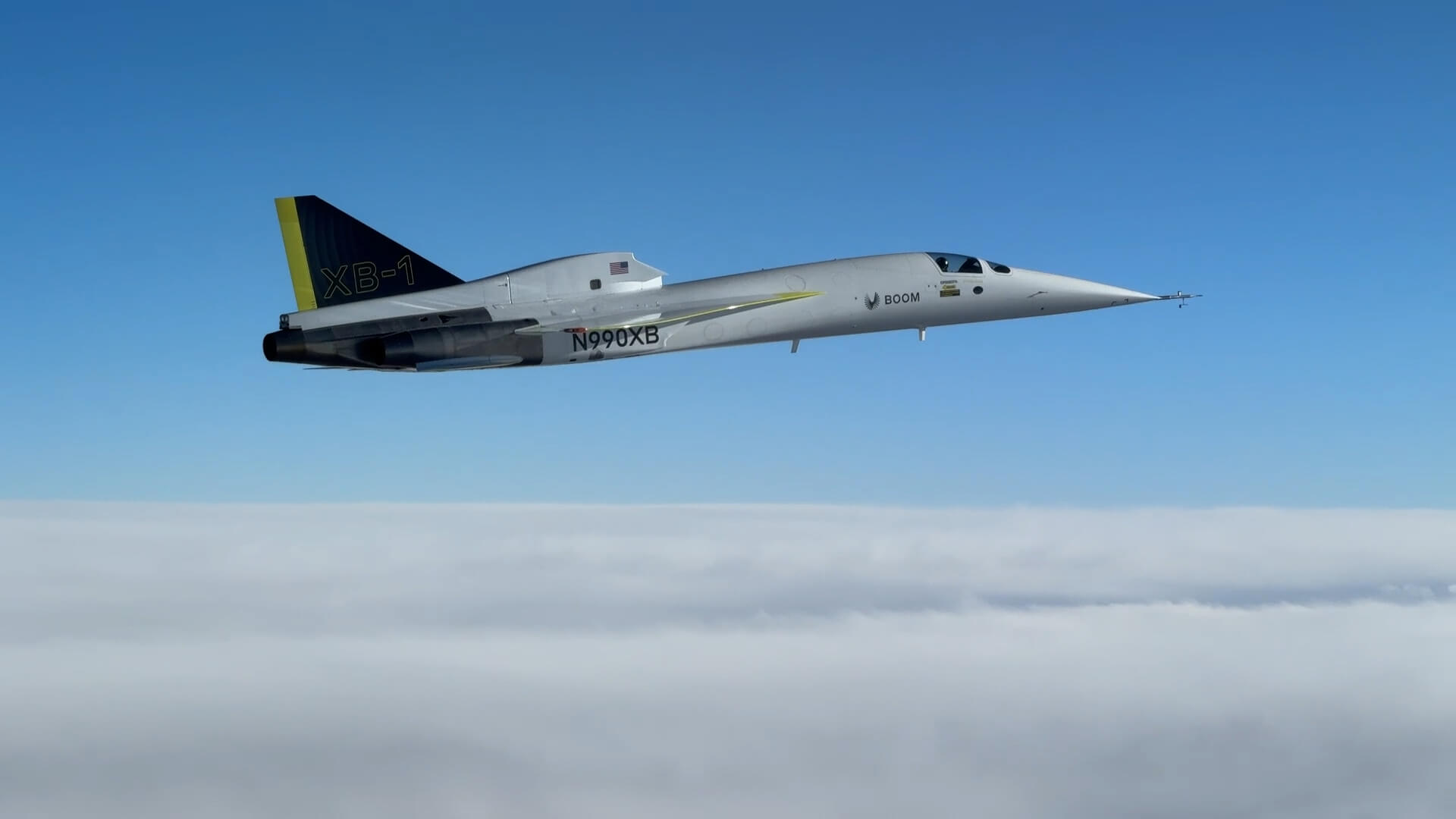
Boom Supersonic, best known for developing next-generation supersonic aircraft, is expanding into the energy sector after securing $300 million in new funding.
The company will commercialize a stationary version of its turbine engine—marking a major strategic shift designed to generate revenue while continuing to fund its aircraft program.
Crusoe Becomes First Customer With a Multi-Billion-Dollar Order
Digital infrastructure company Crusoe has agreed to purchase 29 units of Boom’s new 42-megawatt Superpower turbine, representing a deal valued at $1.25 billion. Once deployed, the turbines will collectively supply 1.21 gigawatts of power to Crusoe’s AI-focused data centers.
Boom Supersonic expects to share details about a dedicated turbine factory next year, with initial deliveries slated for 2027.

Funding Round Brings New Firepower
The $300 million round was led by Darsana Capital Partners with participation from Altimeter Capital, Ark Invest, Bessemer Venture Partners, Robinhood Ventures, and Y Combinator.
Revenue from the Superpower line will directly support Boom’s long-term ambition: bringing its Overture supersonic passenger aircraft to market.
CEO Blake Scholl compared the strategy to how SpaceX used Starlink to finance rocket development, noting the search for a scalable revenue engine had been ongoing for a decade.
“This is the one that clearly aligns with our mission,” Scholl said.
A Shared Architecture Between Flight and Power
Boom’s new stationary turbine and its flight engine, Symphony, reportedly share 80% of the same components. Earlier this year, Boom’s XB-1 demonstrator became the first privately developed civilian aircraft to break the sound barrier—a milestone the company views as foundational for Overture.
For Crusoe, Boom is providing the turbines, generators, control systems and preventive maintenance. The data-center operator will handle installation requirements, including emissions equipment and grid interconnection.
Cost, Efficiency and Expansion Plans
Crusoe’s deal values the turbines at around $1,033 per kilowatt of generating capacity. While this excludes certain infrastructure costs typically included in aeroderivative turbine projects, overall system expenses are expected to exceed $2,000 per kilowatt once fully installed—placing it closer to the cost of combined-cycle plants than simple-cycle gas turbines.
Boom targets 39% efficiency for Superpower, with work underway on an upgrade path that would allow operators to shift to combined-cycle configurations for significantly higher performance.
The turbines will be delivered in modular shipping-container formats, similar to other aeroderivative units. Boom Supersonic plans to produce its first units using existing facilities before ramping up capacity at a new manufacturing site. Output goals are ambitious:
– 1 GW of turbines in 2028
– 2 GW in 2029
– 4 GW in 2030
A Crucial Bridge Toward Supersonic Flight
While Boom Supersonic pursues certification and scale-up for its aircraft program, the turbine business is positioned as a commercial anchor that could help the company navigate the notoriously difficult scaling phase faced by hardware startups.
If the plan succeeds, Boom Supersonic could accelerate its timeline for returning commercial aviation to supersonic speeds. But the scale of manufacturing needed over the next five years will test whether the company can convert engineering breakthroughs into industrial execution.
